Ice Cream
Have you ever watched a preschooler try to wait in line when ice cream is right in front of them?
It sounds simple.
Stand behind your friend. Wait for your turn. Keep your hands to yourself. Move when the line moves.
But for young children, waiting in line is not just standing still. It is a full-body challenge. Their feet want to move, their eyes are already choosing a flavor, and their little hearts are thinking, “Is it my turn yet?”
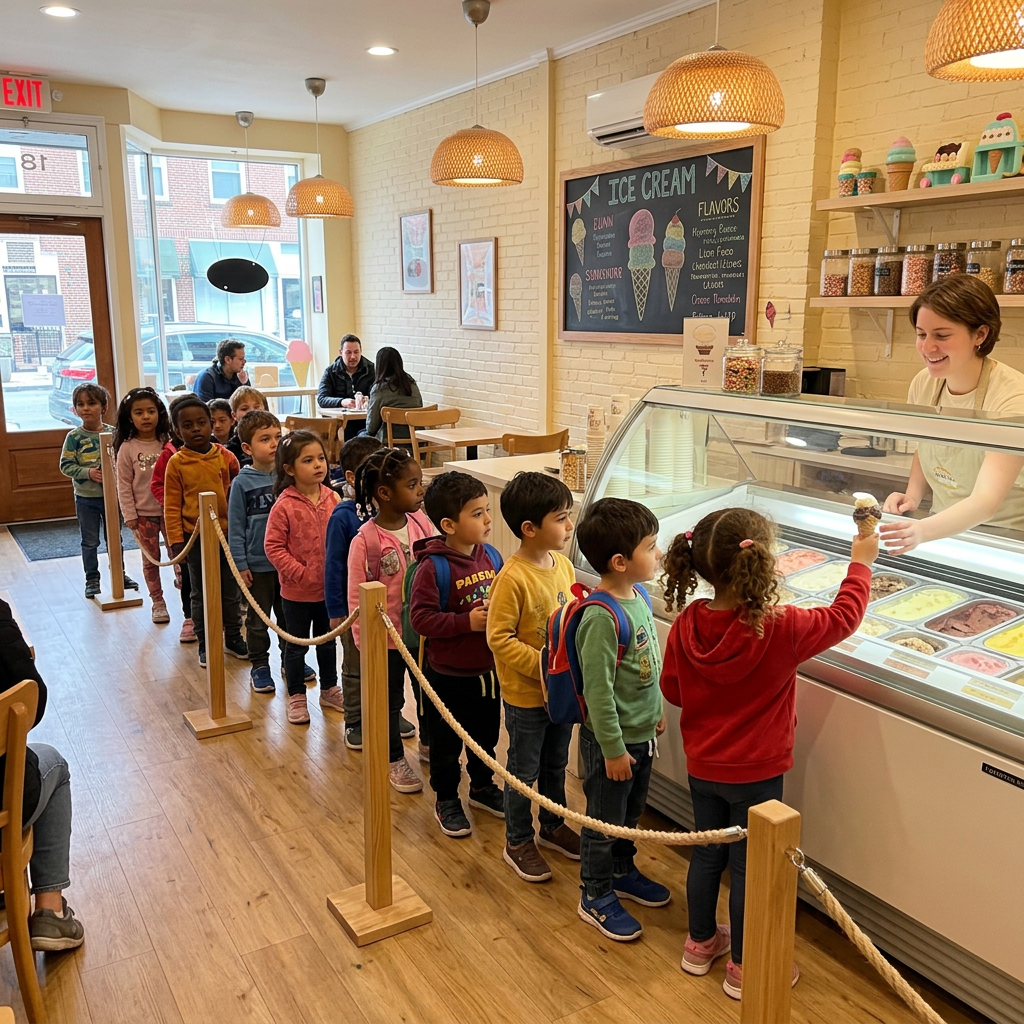
Today, we talked with the children about going to a store and how we wait in line. We practiced what it means to stand behind someone, stay with the group, use walking feet, and wait safely for our turn.
Then we took that lesson outside.
During outdoor play time, the children went to an ice cream store. They had a chance to practice lining up in a real place, with real people, for a very real reward.
Ice cream is a powerful teaching assistant.
Why Waiting in Line Matters
Teaching preschoolers to wait in line is not only about classroom management. It is about helping children understand how to be part of a group.
When children wait, they learn that their turn is coming, even if it is not right now. They learn that friends need space. They learn that we do not push ahead just because we are excited. They learn that a group moves together, not all at once in eight different directions.
That is a big lesson.
And honestly, it is a lesson some adults are still practicing too, especially in a long coffee line on a Monday morning.
What Teachers Notice
From the outside, today may have looked like a sweet trip for ice cream.
But teachers see the small learning moments inside the fun.
We notice the child who remembers to stand behind a friend. We notice the child who needs one more gentle reminder. We notice who gets excited and wants to move ahead. We notice who looks unsure and needs help staying close to the group.
We also notice the little victories.
A child waits without rushing. Another child says, “I’m waiting.” Someone remembers to keep safe hands. Someone who usually needs help follows the line with confidence.
These moments may not look big, but they are signs of growth.
What Parents May See
A parent may hear, “We went to get ice cream today,” and smile.
And yes, it was a fun memory.
But underneath that simple outing, children were practicing real-life social skills. They were learning how to wait in public, how to respect another person’s turn, and how to stay with their class outside the classroom.
Parents often wonder if their child can listen, wait, and follow directions when they are not there. A moment like this gives children a chance to practice those skills in a natural way.
Not through a worksheet.
Not through a long lecture.
Through a line, a teacher’s gentle reminder, a group of friends, and one very exciting ice cream shop.
What Worked Today
What helped today was keeping the directions short and clear.
We used simple reminders:
Stay with your class.
Stand behind your friend.
Use walking feet.
Keep your hands safe.
Wait for your turn.
Young children do better when they know exactly what to do. Short phrases help them focus, especially when their attention is already halfway inside the ice cream freezer.
Today’s Teacher Takeaway
Teaching preschoolers to wait in line is a small routine with a big purpose.
It teaches patience, safety, turn-taking, body control, and respect for others. For teachers, it is a chance to observe growth. For parents, it is a reminder that everyday classroom moments often carry deeper learning.
And for children, it is a sweet way to learn that waiting can be hard, but it can also lead to something good.
Sometimes the lesson is not only in the ice cream.
Sometimes the lesson is in the line before it.
Reader Question: What everyday routine has helped your child or students practice patience in a way that surprised you?
“Let all things be done decently and in order.”
— 1 Corinthians 14:40, KJV


Leave a Reply